
Categories
JCW Saves The Day
- Project: Millhouse Animal Sanctuary
- Location: Fulwood, Sheffield
- Product: JCW V-Groove Acoustic Fencing System
- Fence length: 16.8 linear metres
- Pedestrian gate: 1.2 metres wide
- Application: Reduction of animal noise reaching neighbouring properties
JCW Acoustic Fencing Installed at Millhouse Animal Sanctuary
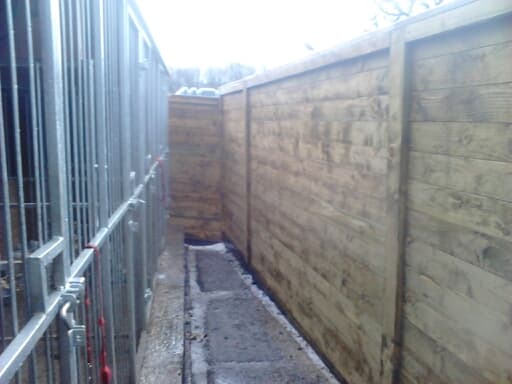
JCW Acoustic Supplies designed and helped install a V-Groove acoustic fencing system at Millhouse Animal Sanctuary in Fulwood, Sheffield.
The sanctuary needed to reduce barking and other animal noise reaching a neighbouring property following a complaint and subsequent council involvement.
The project involved 16.8 linear metres of acoustic fencing together with a 1.2-metre-wide pedestrian gate. The barrier was designed to provide a continuous obstruction between the principal noise source and the surrounding residential area.
The installation supported the sanctuary’s efforts to address the noise concern while continuing its work caring for animals within the local community.
The Noise-Control Challenge
Animal sanctuaries and kennels can produce intermittent noise from several dogs at the same time. Barking may vary considerably according to feeding times, visitors, vehicle movements and activity elsewhere on the site.
Unlike a constant mechanical source, animal noise can change quickly in both level and direction. This can make it particularly noticeable to nearby residents, especially during quieter periods when there is less background sound.
The challenge at Millhouse Animal Sanctuary was to reduce the direct outdoor sound path without preventing staff from accessing the enclosed area or carrying out the sanctuary’s normal work.
The design therefore needed to consider:
- The location of the dogs and kennels
- The position of the neighbouring property
- The height of the noise source
- The available boundary length
- Access through the pedestrian gate
- Gaps beneath and between fence components
- The practical requirements of the sanctuary
Why an Acoustic Fence Was Considered
An outdoor acoustic barrier works by interrupting the direct path between a noise source and a receiving position.
For a barrier to provide a useful reduction, it normally needs to be sufficiently tall and positioned so that the receiver cannot see the principal source over or around it.
The construction must also provide suitable mass and continuity. A lightweight decorative fence containing open joints will normally allow considerably more sound to pass through than a purpose-designed acoustic barrier.
The JCW V-Groove system was selected to create a solid barrier along the relevant section of the sanctuary boundary.
How the JCW V-Groove System Works
The V-Groove fencing system uses closely fitted timber components to create a substantial and continuous surface.
The design is intended to minimise open gaps through which airborne sound could pass directly.
An effective acoustic fencing installation depends on more than the panels themselves. Important details include:
- The finished height of the fence
- The depth and stability of its supporting posts
- The fit between adjoining panels
- The treatment of the bottom edge
- The position of gates and access points
- The total length of the barrier
If the barrier stops too soon, sound may travel around its ends. If there are large openings beneath it, sound may continue through those gaps.
The complete installation therefore needs to be planned according to the particular source and site layout.
Including a Pedestrian Acoustic Gate
The Millhouse Animal Sanctuary project included a 1.2-metre-wide pedestrian gate so that staff could continue to access the enclosed area.
Gates can become weak points within an acoustic fence because they require moving joints and clearance to open correctly.
An acoustic gate should therefore be designed to remain as consistent as practical with the surrounding barrier.
Relevant considerations include:
- The mass and construction of the gate
- Gaps around its sides and bottom
- The hinges and supporting posts
- The latch and closing arrangement
- Whether it returns to the closed position after use
Leaving an acoustic gate open will significantly reduce the effectiveness of the barrier while the opening remains exposed.
The Importance of the Direct Line of Sight
One of the main principles of outdoor acoustic barriers is interrupting the direct line of sight between the source and receiver.
If a neighbouring window can still see over the barrier to the kennels or dogs, the potential reduction may be limited.
Barrier geometry is influenced by:
- The height of the animals and kennels
- The ground level on both sides
- The height of nearby windows
- The distance from the source to the fence
- The distance from the fence to the receiving property
A fence may offer a useful reduction at ground-floor level while providing less benefit to an upper-floor window overlooking the site.
This is why acoustic fencing should be assessed for the actual site rather than selected solely according to panel thickness or appearance.
Reducing Sound Rather Than Creating Silence
No outdoor fence can create complete silence around an active animal sanctuary.
Sound can travel over the top of a barrier and around its ends. Weather conditions, ground contours and reflections from nearby buildings may also influence how barking is heard beyond the site.
The objective of the Millhouse installation was therefore to reduce the direct transmission of animal noise towards the neighbouring area.
The finished result would depend on factors including:
- The number of animals barking
- The original sound level
- The position of the animals
- The frequency content of the barking
- The fence dimensions and location
- Alternative paths around the barrier
Acoustic fencing should be viewed as one element within a wider noise-management approach rather than a guarantee that the source will become inaudible.
Combining Barriers with Noise Management
Physical barriers can be supported by practical measures within the sanctuary.
Depending on the operation of the site, these may include:
- Positioning dogs farther from sensitive boundaries where possible
- Keeping external gates closed when not in use
- Reducing unnecessary activity during quieter hours
- Maintaining kennel doors and equipment to prevent avoidable noise
- Using buildings and existing structures as additional screening
- Monitoring the areas and times associated with the most barking
Source management and acoustic fencing address different parts of the problem. Used together, they may provide a more effective approach than relying on the boundary barrier alone.
Installation Before Christmas
The JCW V-Groove acoustic fence was erected before Christmas as part of the sanctuary’s response to the noise concern.
The project required the barrier and pedestrian gate to be installed securely while preserving access for the people caring for the animals.
Outdoor fencing must be capable of withstanding normal weather exposure and wind loading. Posts, foundations, timber components and fixings should all be suitable for the dimensions and location of the completed structure.
Boundary ownership, underground services and any applicable planning requirements should also be checked before a substantial acoustic fence is installed.
Supporting the Sanctuary’s Continued Work
The completed installation helped Millhouse Animal Sanctuary respond to concerns about noise reaching the neighbouring property.
By introducing a purpose-designed barrier between the animals and the sensitive boundary, the sanctuary was able to take practical steps towards reducing the direct sound path.
The project also demonstrated how acoustic fencing can be adapted to locations where ordinary boundary treatment may not provide sufficient mass or continuity.
Applications can include:
- Animal sanctuaries and kennels
- Veterinary and boarding facilities
- Mechanical plant and heat pumps
- Commercial yards and service areas
- Industrial equipment
- Road traffic affecting outdoor areas
Each site should be assessed individually because the source position, ground level and surrounding properties will affect the design.
Planning an Acoustic Fencing Project
Before selecting an acoustic barrier, establish:
- Where the noise originates
- Which property or outdoor area needs protection
- The direct line of sight between the two positions
- The height and length required
- Whether gates or other openings are necessary
- How sound may travel around the ends
- Whether planning or boundary restrictions apply
A well-positioned, continuous barrier is generally more useful than a taller or heavier fence installed without considering the site geometry.
Discuss Acoustic Fencing for Animal Noise
The most suitable barrier will depend on the source, site layout, neighbouring properties and access requirements.
Explore JCW acoustic fencing and barrier systems, or call Acoustic Supplies on 01204 548400 to discuss an outdoor noise-control project.